Published in Volume 36.4 of Quality Matters, Spotlight Article
The Revolution Starts Now: Reinventing Quality Assurance Without Reinventing the Wheel
Anthony Jones
Syneos Health
This is part one of a proposed series of articles written as a companion to the SQA Course "New Skills for QA Professionals" scheduled to be held at the September 2020 SQA Quality College.
We are at a particularly significant juncture in the ongoing episode of Black Mirror a that is our reality in 2020. Is the world on the brink of an unprecedentedly disruptive digital transformation that will redefine industries and world orders?1 Or, are we slowly slipping into stagnation, unable to develop further, succumbing to bureaucracy, outdated systems and the consequences of past rapid growth?2 Whichever possibility is played-out, it is the moment for the Quality profession to step to center-stage, bringing its cool-headed voice of reason to prevent this episode from ending in the usual manner. To play the parts we must embrace the idea of Quality 4.03, and place ourselves firmly in the vanguard of digitalization, helping to anticipate and solve the quality challenges that arise. We can actively prevent the stagnation scenario by improving the quality of work and life, fostering innovation, fighting bureaucracy, promoting agility and enhancing critical thinking. This will require not so much acquiring "new" skills--in the sense of us all becoming Python programmers, or permaculture professionals--but, rather, taking a fresh look at the existing competencies that will be most valuable right now. These skills are well-researched and documented, however observation4 tends to support the "stagnationist" view that we have been slow to integrate these into work practices. There are, of course, genuinely new skills that will be extremely valuable, not least in the digital domain5 but we don't need to reinvent the wheel. Instead, we can borrow an older analogy from Jim Collins, who proposed the idea of a flywheel 6, 7 as a metaphor for building impetus and momentum in any endeavor:
Picture a huge, heavy flywheel--a massive metal disk mounted horizontally on an axle, about 30 feet in diameter, 2 feet thick, and weighing about 5,000 pounds. Now imagine that your task is to get the flywheel rotating on the axle as fast and long as possible. Pushing with great effort, you get the flywheel to inch forward, moving almost imperceptibly at first. You keep pushing and, after two or three hours of persistent effort, you get the flywheel to complete one entire turn. You keep pushing, and the flywheel begins to move a bit faster, and with continued great effort, you move it around a second rotation. You keep pushing in a consistent direction. Three turns...four...five...six...the flywheel builds up speed...seven...eight...you keep pushing...nine...ten...it builds momentum ... eleven...twelve...moving faster with each turn...twenty...thirty...fifty...a hundred. Then, at some point--breakthrough! The momentum of the thing kicks in in your favor, hurling the flywheel forward, turn after turn ... whoosh! ...its own heavy weight working for you. You're pushing no harder than during the first rotation, but the flywheel goes faster and faster. Each turn of the flywheel builds upon work done earlier, compounding your investment of effort.
It's a compelling metaphor for the power of defining a core cycle of activities that generate desired outcomes: aligning workforces (and individuals), cutting through busyness and focusing on what's really important in a way that becomes self-sustaining. This wheel analogy does not need reinventing, however a small adjustment can make it more powerful, just by picturing a waterwheel in place of a flywheel. To make this easier, here's a picture of a waterwheel:
Figure 1: A Waterwheel


Like Jim Collins' wheel it can be pushed manually, however real momentum is derived from the flow of water pushing its paddles. Now, imagine a metaphorical waterwheel for Quality Assurance (QA), revolving counter-clockwise and consisting of a series of steps from data through to outcomes as shown in Figure 2.
Figure 2: The Waterwheel

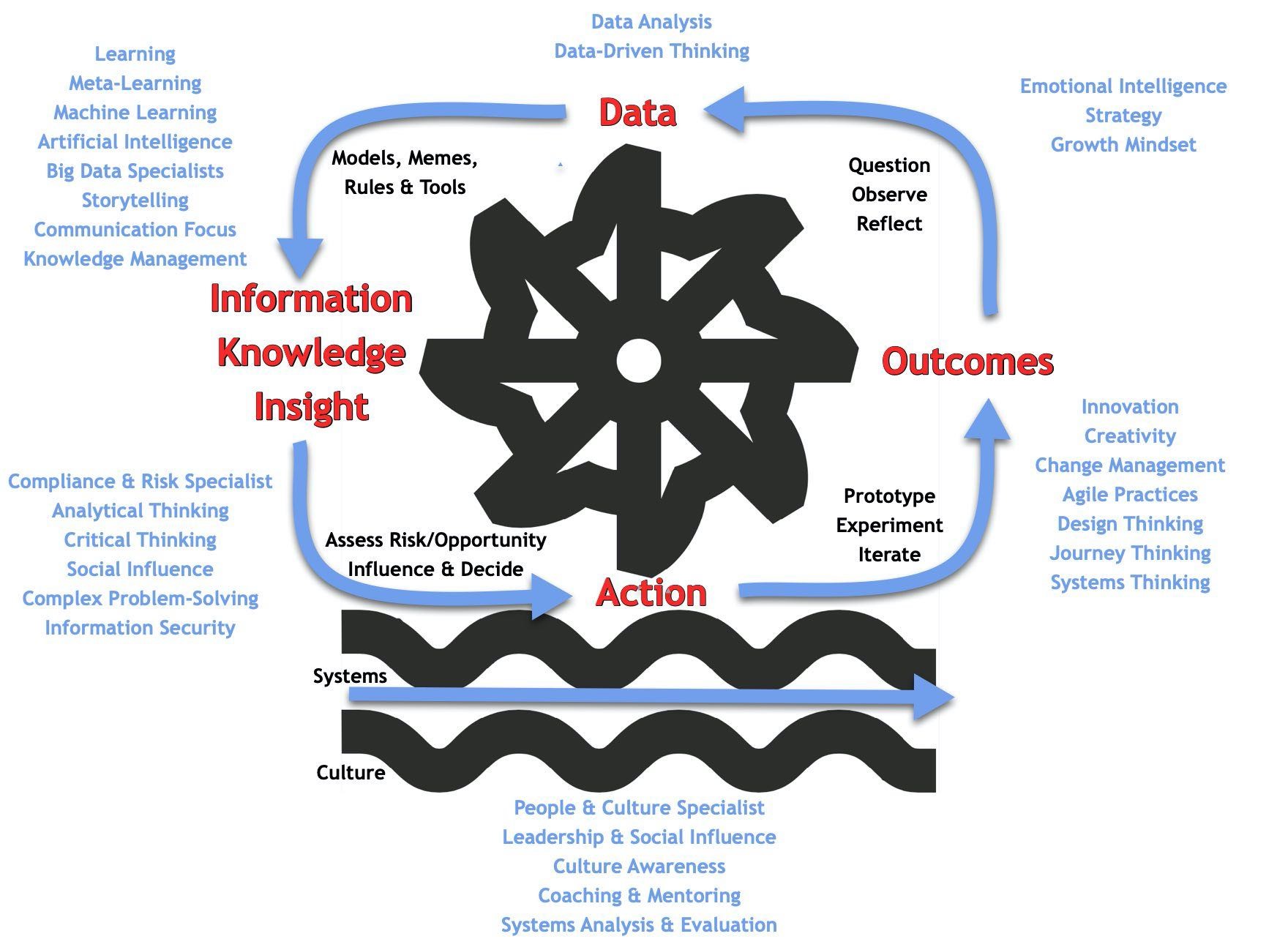
The core cycle is shown in large red text and the inner black text describes the steps in turning the wheel. In summary, fitting models to data (be they mental models fitted to observations or statistical models fitted to data) produces information. Risk assessment leads to decisions and prioritization of actions, then a process of experimentation and iteration results in outcomes. Observation and reflection on outcomes produces further data to drive subsequent revolutions. The "water"--the real power behind the wheel--consists of systems and culture, those less visible forces that have most influence on behaviors and actions. The smaller blue text around the periphery has been added to shows roles and skills culled from a variety of recent literature on re-skilling needs over the coming decade 8,9,10. This model is used to:
- Provide a guide for the skills and techniques that will be valuable for Quality professionals to acquire now and in the coming years.
- Promote data-driven generation of insights, risk-based (and opportunity-based) action and an awareness of outcomes (rather than just action-tracking). The model is simple to keep in mind and can guide QA in their choice of focus areas, improving the quality of data, the quality of data presentation, and the quality of decisions and outcomes. It also reinforces the idea that the highest positive impact on quality is achieved by acting at the level of systems and thinking, shifting from the downstream detection of problems to upstream intervention to influence attitudes and behaviors.
Subsequent articles will describe how we in QA can use this to create change in ourselves and in our organizations. Until then, maybe this simple vision is useful in stimulating thought on how to systematically add value and organize to attain better quality outcomes. At this point in our world we are in need of a revolution, either to herald-in the digital transformation, and/or to combat worsening stagnation. Turning this proposed wheel is literally a revolution, and, to echo Steve Earle's urgency: "the revolution starts now"11.
a. Black Mirror is a British dystopian science fiction anthology television series that examines modern society, particularly with regard to the unanticipated consequences of new technologies.
References
- The Future Is Faster Than You Think: How Converging Technologies Are Disrupting Business, Industries, and Our Lives.Peter H. Diamandis & Steven Kotler; Simon & Schuster, 28 January, 2020.
- The Decadent Society: How We Became the Victims of Our Own Success. Ross Douthat; Simon & Schuster, 25 February, 2020
- Quality 4.0: The Future of Quality? Juran Blog https://www.juran.com/blog/quality-4-0-the-future-of-quality/ (last accessed 8 July 2020)
- Tony's personal opinion 2010-2020
- Udemy for Business, 2020 Workplace Learning Trends Report: The Skills of the Future https://info.udemy.com/rs/273-CKQ-053/images/2020_Workplace_Learning_Trends_Report.pdf (last accessed 8 July 2020)
- The Flywheel Effect. Jim Collins Concepts https://www.jimcollins.com/concepts/the-flywheel.html (last accessed 8 July 2020)
- Good to Great: Why Some Companies Make the Leap and Others Don't. Jim Collins;HarperCollins, 2001.
- World Economic Forum, The Future of Jobs Report 2018, http://www3.weforum.org/docs/WEF_Future_of_Jobs_2018.pdf (last accessed 8 July 2020)
- The Changing Role of Quality in the Future: Required Competencies for Quality Professionals to Succeed. Elizabeth A. Cudney and Elizabeth M. Keim; The Journal for Quality & Participation, January 2017.
- As Industry 4.0 continues to evolve, what can quality pro-fessionals do to ensure they will be an integral asset throughout this industrial revolution? Shannon Connell; American Society for Quality, Quality in Mind, 10 July, 2017.
- The Revolution Starts Now, Steve Earle; E-Squared Records 2004.